
Skip content?
Support in Great Britain 24/7

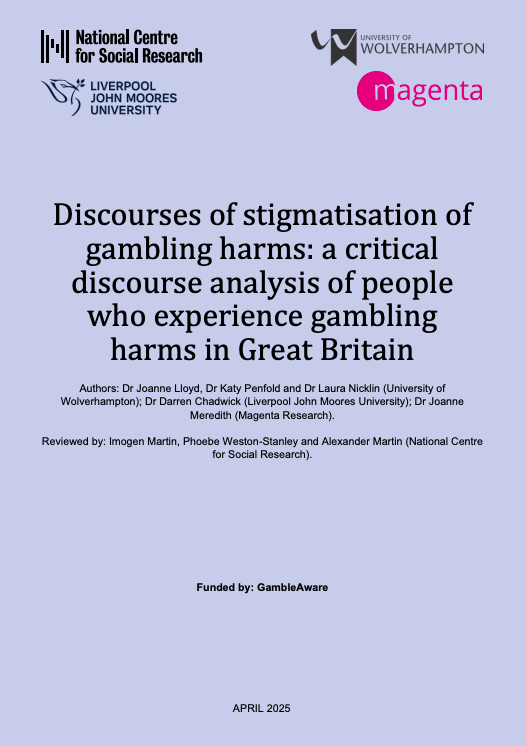
Discourses of stigmatisation of gambling harms: a critical discourse analysis of people who experience gambling harms in Great Britain

Author: Dr Joanne Lloyd, Dr Katy Penfold and Dr Laura Nicklin (University of Wolverhampton); Dr Darren Chadwick (Liverpool John Moores University); Dr Joanne Meredith (Magenta Research) Published: June 2025
Summary

This report presents a critical discourse analysis examining how people who experience gambling harms are portrayed in contemporary British media, politics, and public discourse. Drawing on data from television, political speeches, online forums, and more, the analysis explores the ways in which language and narratives contribute to or challenge the stigmatisation of gambling harms.

Topics covered

  • How gambling harms are portrayed in the media and public conversations.
  • Messages and narratives found in political, industry, and civil society communications.
  • The role of language in shaping stigma across news, television, and online platforms.
  • How people who experience gambling harms are framed — as responsible, disordered, or victims.
  • Implications of these portrayals for designing effective stigma-reduction strategies.

Key findings

  • Public discourse often frames gambling harms as a result of individual failure, reinforcing stigma through narratives of personal responsibility and choice.
  • People who experience gambling harms are commonly constructed in three ways: as psychologically disordered, as morally or behaviourally flawed, or as passive victims.
  • Language used in media and political discourse often reinforces stigma through possessive pronouns (e.g. “his addiction”), emotive or dramatic expressions, and contrasting language that implicitly devalues those with gambling harms.
  • Positive descriptors for people who gamble but don't experience harm (e.g. “responsible” or “harmless”) may indirectly stigmatise others by comparison.
  • These discursive patterns highlight the need for targeted stigma-reduction initiatives that challenge harmful narratives and promote more nuanced, compassionate representations.
Is this page useful?

Get free, confidential support in Great Britain whenever you need it.

However you’re feeling right now, we’re here to help.

Call or chat online to an adviser, and speak one-to-one for confidential advice, information and support.

These support services are available only to Great Britain residents.
